“Rigor and Wonder”

I was just listening to a podcast featuring Natalie Nixon the other day, and she provided possibly the best definition of creativity ever — the ability to toggle between rigor and wonder.

As she points out, most of us are naturally more given to one or the other of these modes, but the good stuff happens when we learn to move between the two with intention and discipline.

And isn’t it especially clear these days that there’s so much more to life than either magical thinking or statistics alone?

***

More on Natalie: https://www.figure8thinking.com/about/

The Way We Live Now

Three ways to think about what we’re seeing — and all we’re going to see in the coming months — in our cultural discourse:

  • How will we live together?
  • How will we make a living?
  • How will we live upon the earth?

The old consensuses about all of those questions (if they ever existed) are fraying or gone, and new evidence is daily emerging that they did not work especially well then and would not be broadly acceptable or sustainable today.

The devil, as always, will be in the details — but it will be broadly possible to judge the direction of travel in someone’s thought, assertion, or politics along each of these three lines.

As you read and listen, ask yourself: can I live with the consequences of this argument? Can all of us?

Nailed It: Adios

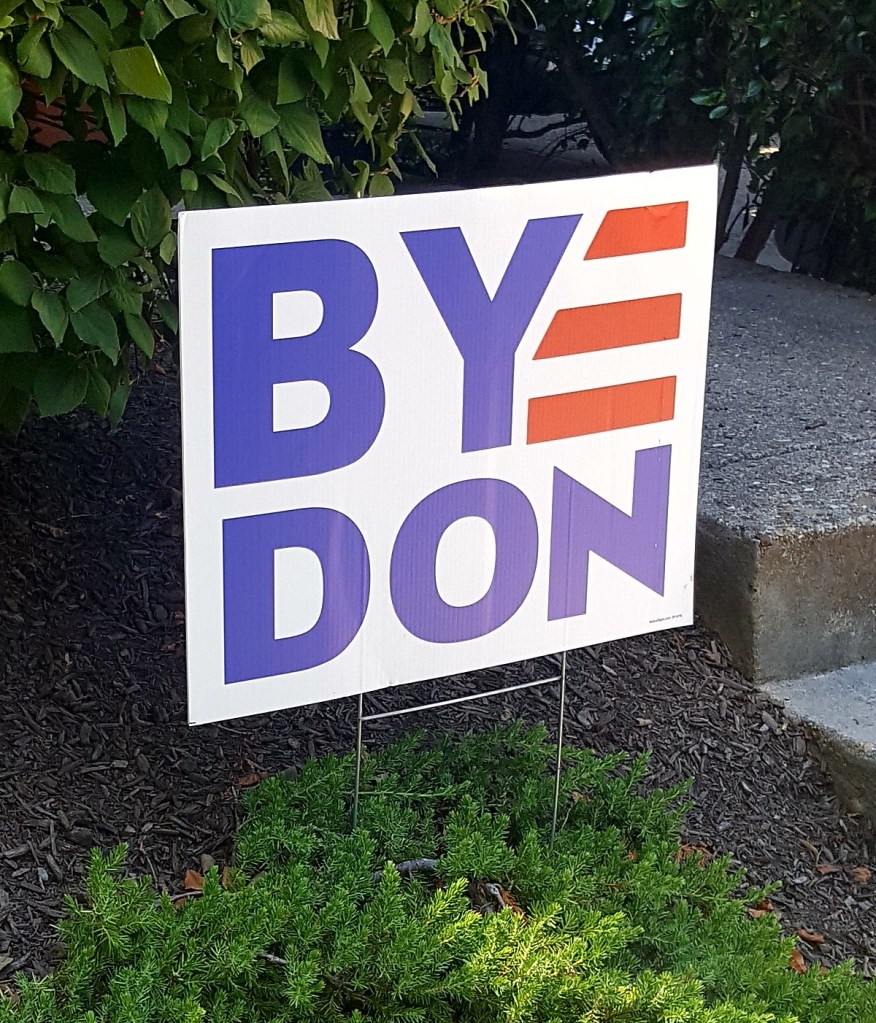
Hats off to the brilliant marketer who figured this out:

In addition to a very clever near-homophone, it’s the marketing trifecta in six letters:

Who’s it for?
What’s it for?
What’s the promise?

It’s arguably the broadest “who” of any sign I’ve seen this season — and it works so well because the “what” and the promise are so clear.

Flip it back around, and it’s the entire campaign — and the stakes — neatly summed up.

¡Adios!

More … and Better?

The op-ed pages (the ones I’m reading, anyway) seem to be taking it for granted now that government is suddenly in the ascendency.

That there’s more of it is not in question — at least if you look at central-bank interventions in worldwide economies. These are unprecedented, and, sadly, they are too often the primary way that citizens are experiencing government, especially in the West, and most especially in the United States. (Think about it: beyond personal payments and business lending facilities, what else have you actually felt from the federal government?)

But there’s another assertion tied to this one that I’m not so sure about: that citizens have suddenly seen the need for better government, and are demanding it.

Sadly, I’m not so sure about that. I’m more prepared to believe that more people are seeing the cost of bad government, but it’s a few steps from there to real, actionable agendas for effective government, and I’m not seeing enough momentum there yet.

On the bright side, many of those for whom the system has been working just well enough (including me) are getting a lot less comfortable. But on the downside, the current administration is clearly only too happy to keep undermining credibility, scope, and effectiveness generally. (“Don’t waste a crisis,” indeed: it’s a perfect time to roll back environmental regulation and step up deportations.)

Good governance is like clean air or water: you generally don’t notice it when it’s working, but you’ll really miss it when it’s gone.

Social Contracts and Constructs

The best thing I read all week was the FT’s weeklong series on “the new social contract.” From citizenship to “generation as the new class” to U.S. companies’ addiction to debt, it’s a comprehensive, compelling, and chilling look at where we are and how we got that way.

On a completely different note, Paul Graham’s vintage essay “Why Nerds are Unpopular” really hit home this week. [HT Farnam Street]

The Great Deleveraging

In a fantastic long essay in yesterday’s Financial Times, the Millennials are referred to as the “recessionals.”

For so many of us, of whom so much has been expected for so long, the beginnings of our careers were marked by the financial crisis. Even throughout the longest bull market in history, “these tough economic times” remained a constant trope of the hiring and employment landscape.

Then, of course, came Covid — and a steeper and deeper crash, with broader and perhaps stickier changes in how we live and work.

Next up, runs the increasingly common wisdom, is the real climate crisis/adjustment. And, along the way, we’re finally facing some deeply rooted problems with how our society, culture, and economy have been structured.

It’s not too early to conclude that those of us born around the turn of the millennium have been and will continue to be a transitional generation. If you consider how many of us were raised with notions of public service (or world-saving), there might be a way to spin that as an enormous service to our countries and species.

But that’s a lot to ask. Depending on what kinds of adjustments we make or fail to make, this generation might be asked more, over more time, than any previous one.

This has to be recognized in some way. Two giant recessions in, too many recessionals are still just getting started — and we have to assume there will be more recessions to come.

It’s senseless — and extremely politically risky — to condemn this generation to keep bearing the burden of our culture’s great deleveraging forever, for lack of a better idea.

If we’re going to be the transition, how might we at least become the leading edge of what’s coming (in a good way) rather than the trailing edge of what was?

Dedication vs. Commitment

Dedication is showing up and doing the work as best you can.

Commitment is deciding to stick with the work (or the person, or the idea, etc.) even when the going gets tough.

There can be great dignity in dedication, but commitment says, This is bigger than me. This might even be bigger than us. I might not finish this work, but I’ll do my part.

Michelangelo’s artisans were no doubt dedicated craftspeople. But Michelangelo? The reason we’ve all heard of him is because he made a commitment.

Non-Dual and Non-Relativist

This is a subtle and often challenging position to take.

It’s also deeply and urgently necessary.

Non-dualism says the world comes in more than two shades: right/wrong, red/blue, my way/highway.

Non-relativism insists that truth and right are still possible and knowable.

This might not be easy, but it’s hard to see another way forward if we’re going to, say, admit ever more voices and experiences and small-t truths to the conversation while still credibly insisting that science is real, racism is wrong, and putting children in cages is evil.